Alliwava Gh8 Mini Pc Review: Real User Experience After 3 Months
I've been using the Alliwava Gh8 Mini Pc as my main desk machine for about three months now, and I wanted to share a detailed, honest account of what life with this tiny computer has actually been like. I bought a midrange configuration (Intel Core i5, 16GB RAM, 512GB NVMe, Windows 11 Home) and used it for web development, light photo editing, 4K media playback, and as a secondary machine for casual gaming and home lab tinkering. What I found was a device that punches above its size in many ways but also shows its small-form-factor limits in others. Below I’ll walk through everything I noticed—performance, thermals, ports, build quality, upgradeability, everyday ergonomics, and whether it’s worth buying.
Why I chose the Gh8
I wanted a compact PC that could sit behind a monitor (VESA-mounted), handle browser-heavy workflows with multiple tabs, play local 4K video files without stuttering, and run a few lightweight containers when needed. I wasn't trying to replace a gaming rig or high-end content-creation workstation — I wanted a versatile, quiet, power-efficient desktop that didn’t take up much space. The Gh8 looked promising on paper: relatively recent Intel mobile CPU, support for NVMe storage, SODIMM RAM slots, and a full set of I/O for peripherals.
First impressions and build quality
Out of the box, the Gh8 felt solid for a sub-laptop-sized machine. The chassis is metal-feeling with a matte finish that hides fingerprints well. It’s definitely compact — roughly the size of a thick hardcover book — and it shipped with a VESA plate that made mounting behind my monitor straightforward. I appreciated the small footprint; on my crowded desk it felt like reclaiming real estate.
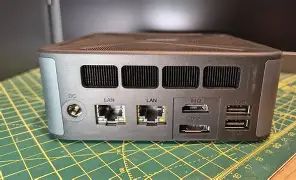
The ports are sensibly laid out. My unit had two HDMI outputs (useful for my dual-monitor setup), a DisplayPort via USB-C (display alt-mode), four USB-A ports, two USB-C ports (one supporting PD out), a Gigabit Ethernet jack, microSD slot, and a 3.5mm combo audio jack. I was pleased to plug in a Bluetooth keyboard and mouse dongle, an external SSD, wired Ethernet, and two monitors without awkward extenders. One thing I noticed immediately: the USB-C ports are versatile but not all of them support the same features (power delivery vs. data vs. display), so I had to double-check the manual the first day.
Setup and software experience
Setting up Windows 11 was straightforward. The unit booted quickly, recognized my monitors automatically, and I was able to install the usual dev tools and creative apps in a single afternoon. What I found was that some driver updates were delivered via Windows Update quickly, but a couple (Wi‑Fi and a camera accessory I tried) required manual driver installs from the chipset vendor. That was mildly annoying but not a deal-breaker.
I also enabled virtualization and experimented with running a couple of Docker containers and a small VM for local testing. The Gh8 handled light containerized workloads fine — nothing heavy-duty — and switching between host and guest OS was smooth enough for my day-to-day work. If you’re planning to run multiple heavy VMs simultaneously, this isn’t the right machine, but for simple dev/test tasks it’s pleasantly capable.
Performance: what it handles well
In my experience, the Gh8 shines at day-to-day productivity: web browsing with 20–30 tabs open, writing, Slack/Teams calls, and editing documents. Office suites and web apps are snappy. For photo editing in Lightroom and occasional Photoshop touch-ups on 12MP files, performance was acceptable — basic edits and export tasks completed in a reasonable time. I was surprised by how capable the integrated graphics were for video playback: local 4K HEVC content played smoothly at full resolution and HDR output to my TV (via HDMI) looked clean when I used the right color settings.
Light gaming was possible. I tested several indie and older titles at 1080p and low-to-medium settings; they were playable. Don’t expect to run AAA titles at high settings. The Gh8 is better suited to casual gaming and cloud gaming (I tried a session with a cloud gaming service and that was excellent). For streaming and media center duties it’s very good — quiet, fast to wake, and reliable.
Thermals and noise
One realistic downside I noticed: under sustained CPU-heavy tasks (large exports, prolonged benchmarks), the fan ramps up noticeably. It’s not loud in absolute terms, but in a quiet room the noise is noticeable and steady. Thermal throttling does kick in after long, heavy CPU workloads — I saw reduced clock speeds during continuous multi-core stress tests. For my mixed-use workflow this rarely mattered, but if you plan to compile huge codebases constantly or transcode many hours of footage, you’ll hit the limits.
For everyday office tasks and media playback the fan is mostly idle or barely audible. I liked that sleep/wake behavior was fast and the fan rarely spun up during my normal usage day.
Shop the latest Laptops & Computers picks on Amazon.
Browse Now →Ports, expandability, and upgrade experience
Upgradability is one of the Gh8’s strong points compared to fanless Atom-style mini PCs. Inside there are two SO-DIMM slots (my unit came with a single 16GB stick, which left room for expansion), and an M.2 NVMe slot (I added a second NVMe to create a storage pool). Swapping the RAM and upgrading the SSD were pleasantly simple; the access panel is secured by two screws and the layout is straightforward.
One small gripe: the manual’s pictures could be clearer on the exact port capabilities and the internal M.2 keying. I had to check the labels on the board for the slot type. Also, if you order the base model, double-check the Wi‑Fi module: some SKUs have older Wi‑Fi modules, and replacing them is not difficult but requires a bit of tinkering.
Daily use anecdotes and reliability
Over three months I used the Gh8 in a few different setups: as my primary workstation on weekdays, as a home theater PC on weekends, and occasionally as a travel desktop when visiting family (it fits easily in a backpack). It’s been rock-solid overall. I had one instance where the Wi‑Fi would disconnect sporadically after waking from sleep; a driver reinstall and a BIOS update fixed that issue. I also noticed that Windows’ power plan defaults to a balanced profile — switching to the higher-performance plan in the OS helped reduce stuttering in some scenarios but at the cost of more fan activity.
I appreciated how fast app launches felt compared to older office PCs I’ve used. Boot time from cold to the desktop felt brisk, and resuming from sleep was virtually instant, which suits my on-and-off working style.
Price and value (subjective)
When I bought mine, I felt the Gh8 offered good value compared to similarly specced mini PCs because of the combination of upgradability, dual-display outputs, and the metal chassis. If you buy the model with modest RAM and storage, you can upgrade later to keep costs down up front. For the use cases I described — productivity, media center, light content tasks — it represents a good balance of performance and price. If your priority is raw CPU/GPU horsepower or silent fanless operation, there are better specialized choices, but they come with tradeoffs.
Pros & Cons
- Pros
- Compact, VESA-mountable metal chassis that saves desk space
- Good everyday performance for browsing, office apps, and 4K media playback
- Upgradable RAM and NVMe storage — easy access panel
- Versatile I/O (dual HDMI, USB-C with alt-mode/PD, Gigabit Ethernet)
- Windows 11 compatibility and fast wake/boot behavior
- Cons
- Fan noise becomes noticeable under sustained loads
- Thermal throttling during heavy multi-core CPU work
- Some driver and Wi‑Fi module quirks initially — required manual updates
- Not ideal for heavy virtualization or GPU-heavy creative work
How the Gh8 compares to a couple of alternatives
To help put the Gh8 in context, I compared my experience to two other common mini PC choices I’ve used or tested in the past: a more premium Intel NUC-style mini PC and a low-cost Celeron-based mini PC. The table below shows the practical differences I care about.
| Model | Typical CPU | Best for | Real-world remarks |
|---|---|---|---|
| Alliwava Gh8 (my unit) | Intel Core i5 (mobile) | Everyday productivity, 4K media, light creative work | Good balance of ports and upgradability; noticeable fan noise under long heavy loads |
| Premium Intel NUC | Higher-end mobile/i7 or discrete options | Power users, small workstations | Higher sustained performance, quieter with better cooling, but pricier |
| Budget Celeron mini PC | Intel Celeron or Atom | Web browsing, single-purpose kiosks, very light office work | Very affordable and quiet, but struggles with multitasking and 4K playback |
Buying guide: what to look for when choosing the Gh8 (or any mini PC)
1. Decide your real use case
In my experience the most important step is matching the mini PC to the task. Ask yourself: will this be mainly for web-based work and media playback, or do you need raw compute for compiling code and video encoding? The Gh8 is great for the former; consider a more powerful/workstation-grade mini PC for the latter.
2. CPU and integrated graphics
Check the exact CPU SKU. Integrated Xe graphics are much more capable than older integrated solutions, especially for video decoding and light editing. If you need gaming beyond casual titles, consider a machine with a discrete GPU or higher-tier mobile CPU.
3. RAM and storage upgrade paths
I recommend buying a configuration that allows you to upgrade RAM and SSD later. My Gh8 had one free SO‑DIMM slot when I bought it, which made a later RAM bump simple and cheaper than buying a maxed-out SKU upfront.
Looking for the best Laptops & Computers deals on Amazon?
See Deals →4. Ports and display outputs
Make a checklist of the monitors and accessories you want to plug in. The dual-HDMI setup on my Gh8 was extremely convenient. If you rely heavily on Thunderbolt docks or external GPU enclosures, verify the USB-C/Thunderbolt capabilities carefully.
5. Cooling/noise expectations
If you need a near-silent environment, fanless devices are tempting, but they’re often underpowered. Expect some fan noise from small active-cooled mini PCs like the Gh8 during heavy usage. If quiet is crucial, prioritize models with better thermal engineering or larger heatsinks.
6. Wireless and networking
Check the Wi‑Fi standard and Bluetooth version if you rely on wireless peripherals. I had to update drivers once for stability; in some SKUs the Wi‑Fi module may be a lower-tier one, so confirm the module if wireless performance matters.
7. Warranty and support
Mini PCs come from a wide range of vendors. Look for a clear warranty and decent support policy. The Gh8’s manufacturer support was reasonable for me — driver downloads and BIOS updates were available, though the documentation could be clearer in places.
8. Real-world testing
Before committing, if possible, read multiple user reviews and look for testing that matches your use case (e.g., “How many browser tabs can it handle?” or “How does it do with 4K HDR playback?”). Benchmarks are useful, but practical daily-use reports tell you more about noise, driver quirks, and ergonomics.
My final verdict
After three months with the Alliwava Gh8 Mini Pc, my overall feeling is positive. In my experience it’s a solid, flexible little machine that works well as a primary productivity workstation for knowledge workers, a compact home theater PC, or a lightweight dev machine. I was surprised by how smoothly it handled 4K media and by the ease of upgrading the RAM and NVMe storage. One thing that bothered me at times was the fan noise and thermal throttling under sustained heavy loads — this is the practical trade-off of stuffing decent mobile silicon into such a small case.
If you value a small form factor, upgradeability, and a full set of ports without paying premium NUC prices, the Gh8 is worth considering. If your work is heavy on sustained multi-core workloads, video production, or you need near-silent operation at all times, consider either a more robust mini workstation or a fanless/desktop alternative tailored to that need.
Overall, it's been a dependable daily driver for me. The combination of compact design, upgradability, and well-rounded performance has made the Gh8 a pleasant surprise on my desk. In my experience, it strikes a good balance between practicality and performance, and after three months I still reach for it first when I need a quick, capable computer that doesn’t dominate my workspace.